Zynfuse
Orthognathic surgery can change how a patient bites, speaks, and feels about facial balance. The implants supporting these procedures therefore deserve close scrutiny. Orthognathic Surgery Implants are not interchangeable hardware; material quality, plate contour, screw stability, and reliable documentation all matter. Small details count. A plate that sits poorly against the bone can complicate an otherwise carefully planned operation.
The World Health Organization’s Global Oral Health Status Report 2022 estimates that oral diseases affect nearly 3.5 billion people worldwide. This figure describes broad oral-health needs, not the number of people who require jaw surgery. That distinction matters. It would be misleading to treat a large oral-disease burden as direct proof of demand for orthognathic implants. For manufacturers in China, more useful comparisons examine documented material specifications, production controls, design options, clinical evidence, and post-market monitoring.
So, which company is the best manufacturer? There is no universal answer. Surgeons and purchasing teams should verify product indications, titanium or other material details, traceability, sterilization information, and applicable regulatory documentation. They should also ask whether the implant system supports the planned procedure and offers dependable technical support. A polished catalogue is not proof of clinical performance. Nor does a low price settle the question. This overview introduces practical criteria for assessing Chinese manufacturers, while recognizing a limitation: public company claims can be difficult to compare without independent, procedure-specific evidence. A careful choice starts with verifiable records, not rankings alone.
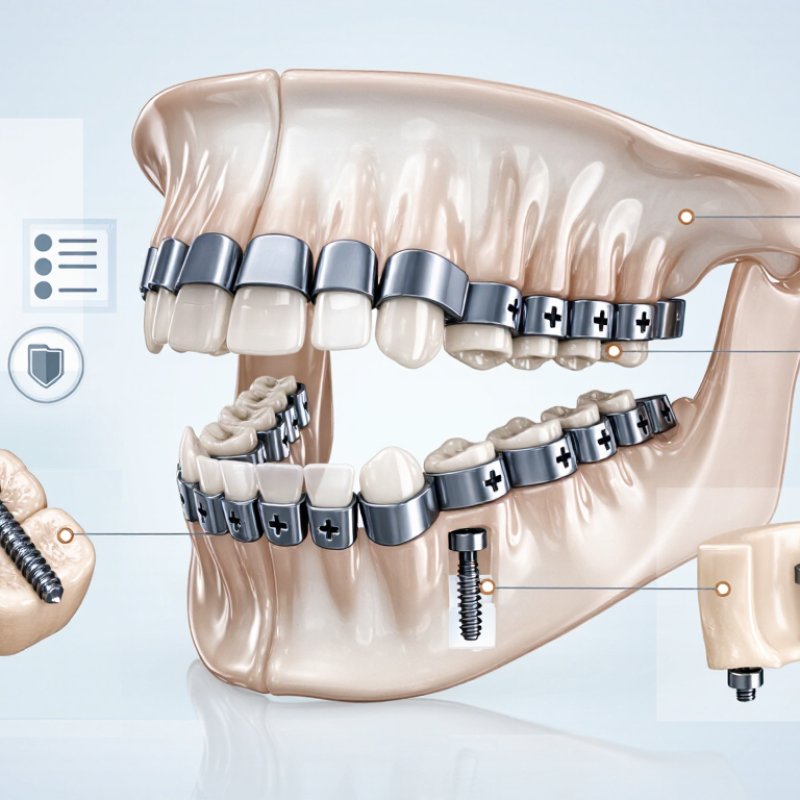
Orthognathic surgery implants are fixation devices used to hold the jaw bones in their new positions after surgery. They commonly include small plates and screws, often made from medical-grade titanium. A surgeon places them beneath the gums, against the bone. They are not cosmetic fillers. Their purpose is to support stability while the bone heals.
The exact devices depend on the operation, the patient’s anatomy, and the surgeon’s plan. Some procedures use standard plates; others may use plates shaped for an individual jaw. Imaging and surgical planning help guide placement, but they cannot remove every uncertainty. Details matter. These devices are usually left in place, though a clinician may consider removal if they cause problems. Possible concerns include infection, irritation, or altered sensation, and individual risks vary. “Implant” can also mean a device that adds volume to the face, so the term may cause confusion. Ask the surgical team what material and fixation method are planned, how follow-up will work, and what symptoms need attention. No device replaces careful diagnosis or ongoing professional care. The explanation can feel incomplete at first; it is reasonable to ask again.
How Are Orthognathic Implants Designed and Manufactured?
Design begins with a patient’s CT scan, converted into a three-dimensional jaw model. The surgeon and engineer plan bone movements together, then shape plates around the planned anatomy. Screw holes must avoid tooth roots and important nerves. Small details matter. A plate that looks elegant on screen may still be difficult to fit during surgery. FDA guidance on additive manufacturing emphasizes that device geometry, material properties, and production conditions all need careful control.
Many patient-specific plates are made from titanium alloy using laser powder-bed fusion. The printed part is then cleaned, heat-treated when required, and finished to remove rough edges and support marks. Critical dimensions and screw holes are checked against the digital design. FDA has reported clearing more than 100 medical devices made with 3D printing; this figure covers many device types, not orthognathic implants alone. Quality systems such as ISO 13485:2016 also help control design and manufacturing records. Still, inspection cannot replace clinical judgment. Fit, handling, and surgical access deserve a final review. There is no perfect workflow. A missed contour can turn a precise plan into a frustrating adjustment in the operating room.
For orthognathic plates and screws, applicable requirements depend on intended use, materials, and device classification. In China, manufacturers generally need to meet National Medical Products Administration requirements, including applicable registration or filing and product technical specifications. Their quality systems are commonly assessed against ISO 13485. Relevant Chinese GB or YY standards may also apply. For titanium implant materials, GB/T 13810 can be relevant; biological safety evaluation may draw on the ISO 10993 series. Risk management under ISO 14971 helps document hazards, controls, and residual risks.
Details matter. A manufacturer should be able to show material certificates, production records, inspection results, and traceability from raw material to finished implant. Sterile products also require validated sterilization and packaging processes, with standards such as ISO 11135, ISO 11137, or ISO 11607 applied where appropriate. Not every standard fits every device. A certificate alone is not enough; check its scope, current edition, and connection to the specific product. Custom-made devices may need additional review. Standards can reduce risk, but they cannot predict healing or surgical results.
That distinction deserves more attention.
China Best Orthognathic Surgery Implants Manufacturer?
How Can You Evaluate an Orthognathic Implant Manufacturer in China?
Start with evidence, not showroom claims. Grand View Research estimated the global orthopedic implants market at USD 49.2 billion in 2023, with projected annual growth of 4.9% through 2030. This broad market figure is not specific to orthognathic devices. It signals industry activity, not product quality. A polished brochure proves little.
Check whether the manufacturer can document material specifications, design controls, validated sterilization processes, and lot-level traceability. Ask for test reports relevant to fixation plates and screws, including mechanical performance and corrosion resistance. Review how the team manages design changes and reported product issues. If patient-specific devices are offered, examine how CT files, planning approval, and production checks are handled. Ask for sample records, not just promises. Small gaps matter.
Tips: Request redacted quality records and a clear production timeline. Confirm that certificates match the actual facility and product scope. Speak with clinical and quality staff, not only sales representatives. If answers are vague, pause. Even strong documentation cannot guarantee a clinical outcome, so evaluate the evidence carefully.
| Evaluation Dimension | What to Check | Evidence to Request or Verify | Practical Evaluation |
|---|---|---|---|
| Product registration and market authorization | Confirm that the specific implant product and its intended use are authorized for the market where it will be supplied. Medical-device classification and registration requirements depend on the product and its intended use. | Product-specific registration or authorization details, device classification, approved indications, and the legal manufacturer information. Verify status through the relevant regulator’s official database where available. | Check the exact product and legal manufacturer; a general certificate or a registration for a different product is not sufficient evidence. |
| Quality management system | Assess whether the manufacturer operates a quality management system appropriate for medical-device design and production. | A current ISO 13485 certificate, its scope, issuing certification body, validity dates, and—where possible—confirmation with the issuer. | Make sure the certificate covers the relevant manufacturing site and activities, rather than relying on the certificate title alone. |
| Material specifications and traceability | Review the implant material, applicable material specifications, supplier controls, and traceability from incoming material to finished device. | Material specifications, inspection records, certificates of analysis or conformity, lot or batch traceability, and change-control procedures. | Confirm that material documentation identifies the grade and applies to the supplied product; do not assume all titanium implants use the same alloy or specification. |
| Biocompatibility and biological safety | Determine how biological safety was assessed for the device’s materials, contact type, and duration of use. | A biological evaluation or risk-based assessment, relevant test reports, and the rationale for any tests not performed. ISO 10993 is a commonly used series for evaluating medical-device biological safety. | Look for evidence that the assessment relates to the finished device and its intended patient contact, not only to a raw material in isolation. |
| Risk management and design controls | Check how the manufacturer identifies, evaluates, and controls risks throughout design and production. | Risk-management documentation, design verification and validation records, design-change controls, and complaint or corrective-action processes. ISO 14971 provides a widely used framework for medical-device risk management. | Ask how risks such as device failure, fit, surgical handling, and manufacturing variation are addressed and documented. |
| Patient-specific planning and manufacturing | If patient-specific implants are offered, review the process for transferring clinical imaging and planning data into the manufactured device. | Documented workflow, file-transfer controls, design approval steps, manufacturing records, and procedures for checking the final device against the approved design. | Clarify who reviews and approves the patient-specific design, how revisions are controlled, and how the final implant is matched to the approved plan. |
| Manufacturing controls and inspection | Evaluate controls for production, cleaning, inspection, nonconforming products, and process changes. | Process-control records, inspection criteria, equipment calibration records, validation records where required, and procedures for handling nonconformities. | Request objective records or an audit appropriate to the relationship; marketing statements alone do not demonstrate process control. |
| Sterilization and sterile-barrier packaging | Establish whether the supplied device is sterile or non-sterile and, if sterile, how sterilization and packaging are controlled. | Sterilization method, validation and routine monitoring records, packaging validation, labeled shelf life, and storage conditions. ISO 11135 and ISO 11137 are examples of standards used for particular sterilization methods; applicability depends on the process. | Check that the method, packaging, and shelf-life claims apply to the exact product and configuration being purchased. |
| Technical documentation and labeling | Review whether instructions and labels clearly state the intended use, compatible components, warnings, storage, and handling requirements. | Current instructions for use, product specifications, labeling samples, revision history, and documentation in languages required for the destination market. | Ensure the documentation matches the authorized product version and is suitable for the intended clinical users and market. |
| Post-market monitoring and complaint handling | Assess how the manufacturer records and investigates complaints, monitors device performance, and manages corrective actions or recalls. | Written complaint-handling and vigilance procedures, escalation contacts, corrective-action process, and relevant post-market records where available. | Ask for response timelines and a clear process for reporting and investigating product concerns after delivery. |
| Supply continuity and change notification | Check production capacity, lead-time controls, continuity planning, and notification of changes that could affect the device. | Capacity and lead-time information, contingency arrangements, supplier-change controls, and a written process for communicating product or process changes. | Compare commitments with documented processes and clarify how urgent or patient-specific orders are handled. |
| Overall decision | Use a risk-based review rather than selecting on price or a single certificate alone. | Completed document review, product-specific regulatory checks, quality-system evidence, and any required technical or supplier audit. | Shortlist manufacturers only after confirming product authorization, traceability, technical suitability, and evidence relevant to the intended market and clinical use. |
A reliable manufacturer offers more than a polished catalog. Look for documented quality systems, material traceability, and clear design controls. ISO 13485:2016 certification is a useful starting point, not proof that every product performs well. Ask for batch records, sterilization validation, and inspection results for plates and screws. The WHO Global Atlas of Medical Devices (2017), based on responses from 125 countries, documented gaps in medical-device regulation and assessment capacity. That makes transparent evidence especially important when evaluating suppliers.
Technical details matter. Request specifications for titanium grade, plate thickness, screw dimensions, and packaging. For custom-made components, check how CT data are reviewed, designs approved, and changes recorded. Ask how the manufacturer tests fit and mechanical strength, and whether production batches can be traced to inspection records. A fast quotation is useful. It is not enough. One uncomfortable question: can the supplier explain a defect investigation without relying on vague assurances?
Tips: Request a sample technical file and a recent quality audit summary. Verify certificates with the issuing body, and compare stated tolerances with the drawings. Small gaps in documentation deserve follow-up.
A CT scan is converted into a three-dimensional jaw model. The surgeon and engineer plan bone movements together.
Holes must avoid tooth roots and important nerves. A small shift can complicate placement.
Many are printed from titanium alloy using laser powder-bed fusion. They are cleaned, heat-treated when required, and finished.
Inspectors compare key dimensions and screw holes with the digital design. Rough edges and support marks are removed.
No. Fit, handling, and surgical access still need review. A missed contour may require frustrating adjustments.
Ask for material specifications, test reports, traceability records, and validated sterilization documentation. Sample records are more useful than promises.
Review how CT files are handled, designs are approved, and production changes are recorded. Small gaps matter.
No. Certification can support quality controls, but it does not guarantee product performance or a clinical outcome. Evidence still needs careful review.
Orthognathic Surgery Implants are devices used to support and stabilize the bones of the jaw during corrective surgery. Their design must account for a patient’s anatomy, the intended surgical plan, material properties, and the demands placed on the implant after placement. Manufacturing typically involves careful design review, precise production, finishing, and inspection to help ensure consistent dimensions, suitable performance, and reliable documentation.
When evaluating a manufacturer in China, buyers can review its quality management practices, applicable medical-device standards, production capabilities, traceability systems, and inspection procedures. It is also useful to assess technical support, communication, customization options, and the clarity of product and quality records. Leading manufacturers distinguish themselves through consistent quality control, experienced engineering teams, dependable delivery, and a willingness to provide transparent information. A thorough evaluation helps healthcare organizations identify a supplier whose capabilities align with clinical needs and procurement requirements.
